
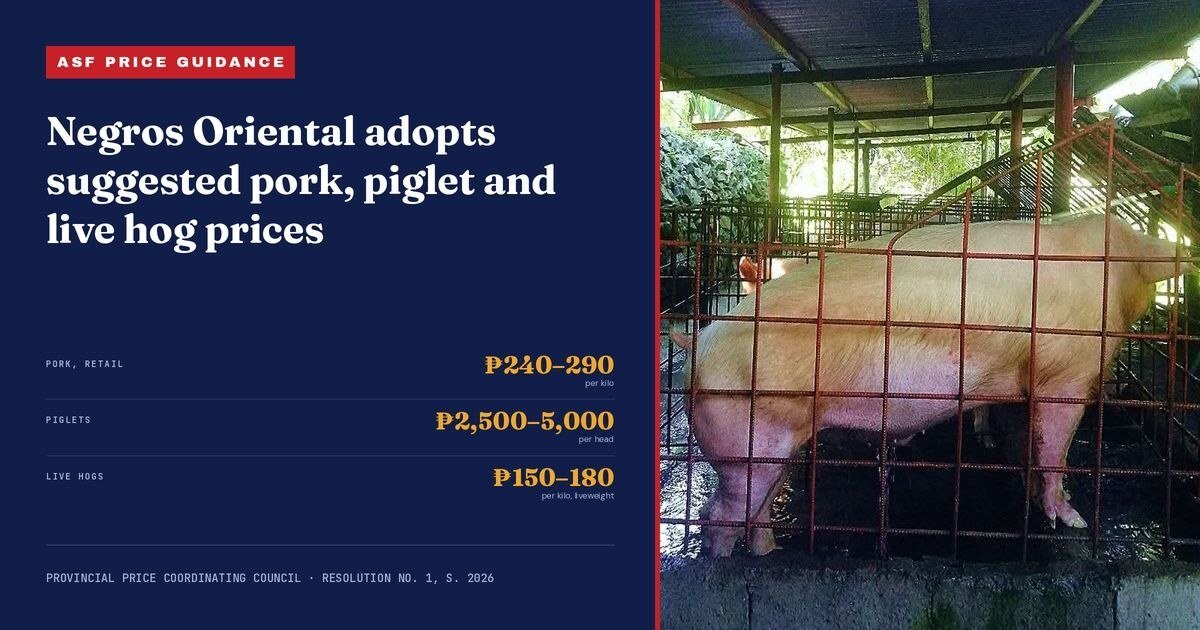
Facing mounting pressure on the local swine industry from the ongoing African swine fever (ASF) outbreak, the Negros Oriental Provincial Price Coordinating Council has formally adopted a set of temporary suggested price ranges covering pork, piglets, and live hogs — providing a province-wide reference framework intended to stabilize markets and protect both consumers and livestock industry workers.
The measure, embodied in Resolution No. 1, Series of 2026, was signed on August 6, 2026 at the Provincial Capitol in Dumaguete City by Governor Manuel L. Sagarbarria. The resolution took effect immediately upon signing, according to the Provincial Price Coordinating Council.
What the Resolution Covers
Under the resolution, the Provincial Price Coordinating Council established a suggested retail price range of ₱240 to ₱290 per kilogram for pork — whether locally sourced or imported. For piglets, the suggested range is ₱2,500 to ₱5,000 per head, while live hogs are covered by a suggested buying price of ₱150 to ₱180 per kilogram liveweight.
The council said the pricing guidelines are explicitly temporary in nature, designed to serve as market guidance during the current period of ASF-driven disruption rather than as permanent price controls. The ranges are intended to discourage profiteering and price manipulation while enabling orderly commerce to continue across the province.
Significantly, the resolution is designed to protect multiple stakeholders simultaneously. It seeks to balance consumer interests against the legitimate cost recovery needs of hog raisers, livestock traders, pork vendors, and lechon operators — all of whom face elevated production, transportation, and operating expenses under current conditions, the council noted.
Process Behind the Resolution
According to the resolution, the Provincial Price Coordinating Council convened on July 25, 2026 at the Provincial Capitol to assess the prevailing market situation for pork, lechon, piglets, and live hogs. The deliberations drew on price monitoring data and assessments conducted by concerned provincial offices and member-agencies in the weeks preceding the meeting.
Following those consultations, the council approved the suggested price ranges that were subsequently formalized and signed into effect by Governor Sagarbarria on August 6. The province had separately imposed restrictions on the movement of hogs and pork products from ASF-affected areas as part of its ongoing containment effort.
Guihulngan City Had Already Acted
The province-wide resolution follows earlier action taken at the local level. Guihulngan City Mayor Filomeno Reyes had already signed Executive Order No. 17, Series of 2026, which set a minimum buying price of ₱160 per kilogram for live hogs and ₱200 per kilogram for pork carcasses, along with a minimum retail price of ₱240 per kilogram for pork — this despite the city having recorded no ASF cases of its own.
The Department of Agriculture’s Provincial Agriculture and Fisheries Technical Coordination Office in Negros Oriental had indicated it was awaiting a province-wide issuance from the governor before a uniform pricing scheme for live hogs and pork could be properly coordinated, according to the resolution. The August 6 signing effectively answered that call.
Local Governments Retain Flexibility Within Provincial Ranges
Component cities and municipalities are not locked into the exact provincial figures. The resolution allows local government units, acting through their respective Local Price Coordinating Councils or other proper authorities, to establish their own localized suggested prices — provided those prices fall within the ranges set by the provincial council.
Cities and municipalities that do not have functioning Local Price Coordinating Councils were encouraged by the resolution to organize or reactivate them. According to the council, local price bodies chaired by their respective mayors may issue advisories, send letters of inquiry, and take other lawful actions against traders or retailers found to be non-compliant with the pricing guidance.
Monitoring Responsibilities Distributed Across Agencies
Enforcement and monitoring responsibilities under the resolution are spread across multiple agencies. Public markets fall under the oversight of municipal or city agriculture offices, administrators’ offices, and veterinary offices. Trading centers, bagsakan centers, and auction markets may be monitored by the Department of Agriculture and its local counterparts. Supermarkets will be covered by the Department of Trade and Industry.
The Provincial Veterinary Office, Provincial Agriculture Office, DTI, and other member-agencies were directed to maintain continuous monitoring of market conditions, supply chain movements, and prevailing prices, and to recommend adjustments to the price ranges when conditions warrant, the council said.
Anti-Profiteering Provisions Retained
The resolution explicitly preserves the provincial government’s authority — and that of other relevant agencies — to pursue additional regulatory and enforcement measures permitted under law. These include actions against hoarding, profiteering, cartelization, and other illegal price manipulation practices. The existence of suggested price ranges does not limit or replace those enforcement powers, according to the Provincial Price Coordinating Council.
The suggested price ranges remain in force until the council itself amends, revises, or formally lifts them.
ASF Situation in Negros Oriental and the Wider Visayas
The ASF outbreak driving these measures has been spreading across the Visayas since late June 2026. Cases were confirmed in Bacolod and in La Libertad in Negros Oriental on July 1, and neighboring provinces have responded by imposing movement bans on swine and pork products.
The pricing pressure is not limited to Negros Oriental. The Philippine Statistics Authority reported that fresh pork kasim averaged ₱339.43 per kilogram nationally during the first phase of July 2026 — a figure significantly above the upper end of the retail range now in effect in Negros Oriental, underscoring how far local guidance can diverge from national averages depending on regional supply conditions.
By the Numbers
- ₱240–₱290 per kilogram — provincial suggested retail price range for pork (local and imported)
- ₱2,500–₱5,000 per head — provincial suggested price range for piglets
- ₱150–₱180 per kilogram liveweight — provincial suggested buying price for live hogs
- ₱160 per kilogram — minimum buying price for live hogs set by Guihulngan City under EO No. 17, Series of 2026
- ₱200 per kilogram — minimum price for pork carcasses set by Guihulngan City
- ₱240 per kilogram — minimum retail pork price set by Guihulngan City
- ₱339.43 per kilogram — national average retail price for fresh pork kasim, first phase of July 2026, per the Philippine Statistics Authority
- July 25, 2026 — date the Provincial Price Coordinating Council convened to deliberate on the measure
- August 6, 2026 — date Resolution No. 1, Series of 2026, was signed by Governor Sagarbarria
Why This Matters
Establishing province-wide suggested price ranges gives consumers, hog raisers, traders, and vendors a formal, government-backed reference point at a time when ASF is disrupting swine supply chains and creating conditions ripe for price manipulation. The resolution also addresses a coordination gap flagged by the Department of Agriculture’s provincial office, which had been holding back on local pricing schemes pending a uniform provincial directive. With ASF confirmed in Negros Oriental and movement bans tightening across the Visayas, the pricing framework represents a structured institutional response to a supply crisis with direct consequences for food security and the livelihoods of thousands of people dependent on the pork industry.
Source: Breaking News Negros Oriental (breakingnewsnegrosoriental.com)